
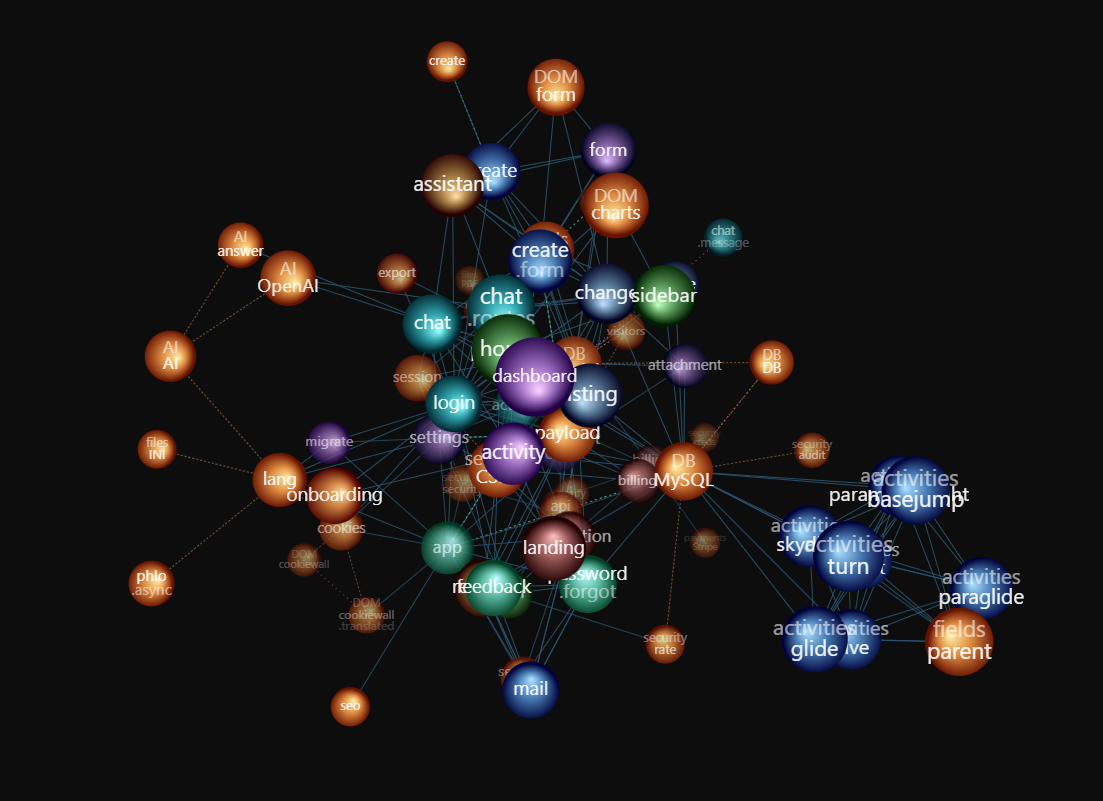
The architecture of sanity: why Phlo's radical simplicity is the future of full-stack
16 February 2026
Modern web development has been locked in a fifteen-year debate that has led us into a complexity trap. We have traded the proven stability of server-side PHP, which still quietly powers 70% of the web, for a fragmented world of hydration mismatches, fragile build chains, and dependency trees no single architect can truly audit. The distance between the layers of a typical stack has grown so large that no one holds the whole picture in their head anymore.
Phlo is a deliberate departure from that norm: a vertically integrated stack (language, application platform, server, and operations) designed to reclaim ownership from these bloated defaults. By collapsing the distance between frontend and backend into a single mental model, it offers a way back to stability, predictability, and technical oversight.
Here are five takeaways from that architecture.
AI agents are first-class citizens
Most frameworks are designed for humans and merely tolerated by AI. Phlo is built on the idea that a framework existing as one closed loop, with a single source of truth, is something an agent can actually understand.
The platform ships a dedicated SKILL.md reference for LLMs, so an agent can work on the codebase without prior training. The workflow starts with reflect::context, a single call that returns identity, route/view counts, loaded packages and recent errors, a quick orientation snapshot, with separate calls available for the full route and view listings themselves. That is part of a two-plane design: reflect:: and build:: run outside the app, fast and reading only the source, while phlo_eval runs inside the live app so an agent can execute code against real data to verify behavior.
The same properties that make Phlo legible to a human (one closed loop, source-mapped errors, a single skill document) make it tractable for an agent, and treating that as a first-class goal multiplies what a small team can do.
The bet on zero dependencies
In an industry where a "Hello World" project pulls in hundreds of megabytes of unauditable vendor code, Phlo's zero-dependency stance is a defense of legibility. For a platform whose whole premise is oversight, a sprawling vendor tree would undercut the architecture from the inside.
Instead of managing a package graveyard, the engine natively handles:
- an integrated CSS transpiler,
- a built-in JS minifier,
- an internal icon-sprite builder,
- a native SPA runtime.
By owning that surface area, Phlo avoids the dependency churn that plagues modern JavaScript stacks, and the engine stays small enough to be understood in its entirety.
A line-based parser, no AST
Phlo makes the surprising choice of a line-based parser instead of a traditional Abstract Syntax Tree. The parser is a few hundred lines, readable in one sitting. Because line N in the .phlo source maps directly to a known line in the generated PHP, source-mapping is close to free, and error pages are exceptionally precise.
The rule set is strict: a statement ends at the line break, and a line ending in (, [, {, }, , or . is treated as an implicit continuation. The trade-off is real: a blank line terminates a view, so you cannot use blank lines for visual spacing inside an HTML block. Phlo's answer to that is better diagnostics, not a more forgiving parser: a violation stops the build with the file and line, immediately. A looser grammar would relax the rule at the cost of the parser's own legibility, and that is not a trade Phlo makes.
Realtime as an additive step, not a requirement
Phlo Realtime adds a WebSocket layer that is additive rather than foundational. An app stays a normal request-response app and only "lights up" with realtime behavior once the Phlo Daemon is running alongside it.
It is an in-process model: the daemon owns the socket connections and dispatches events (auth, connect, receive, close) to your app through the same worker pool used everywhere else, a one-shot process per event on a dev host, a resident pool on a release host with no per-event startup. Because socket events are handled exactly like routes either way, there is no special runtime to learn, and the database stays the source of truth instead of state living in long-lived memory.
Reclaiming ownership from the cloud default
The "serverless" default bills per request, so cost scales with success. Phlo returns to a model where cost tracks the machine, not the request volume: the bill stays predictable whether you have ten users or ten thousand.
Phlo scales horizontally with identical, share-nothing nodes behind a load balancer. To go further, worker mode keeps the app resident in memory, and objPers lets an expensive resource such as a database connection survive between requests, so a worker doesn't pay a fresh connection cost on every call. Setting prop %MySQL.objPers = true buys the performance of a resident pool without giving up the simplicity of the plain PHP model.
The point of all of it
Phlo's aim is to give a small team the oversight that a fragmented stack usually costs them. It unifies language and platform through the apply() protocol: the server sends DOM commands, the client applies them, and there is no hand-written client-side glue to keep in sync with the backend.
The most useful move available right now may not be more abstraction, but a model small enough to actually hold in your head: affordable, owned, and built to work with both a human and an agent at the keyboard.