
The death of rented capacity: reclaiming the full stack with Phlo
24 February 2026
Web development is in the middle of a complexity crisis. The pitch has always been that "industry standards" require navigating dependency trees too deep to audit and frameworks that churn faster than anyone can master them. Along the way we accepted a model of rented capacity, where cloud-native defaults let a hosting bill bend upward exactly when a product succeeds.
That ceremony does more than slow teams down: it works against the basic idea of owning what you build. Phlo is a deliberate step away from it, a vertically integrated platform and language designed to give a single person or a small team back the one thing modern best practices quietly took away: real ownership of the software they ship.
The zero-dependency zen
Modern development often feels like building on shifting sand: thousands of third-party packages nobody has time to audit, creating exactly the kind of abstraction leakage that compromises security and stability. Phlo rejects that fragmentation with a genuine zero-dependency stance.
The engine is a closed loop. It ships its own CSS transpiler, JS minifier, icon-sprite builder and SPA runtime, and arrives with over 150 bundled resources instead of a fragile package tree. Composer stays supported as an optional convenience, but the core engine has nothing to audit but itself. Every unnecessary layer adds a barrier between a developer and the software, until no single person holds the whole picture anymore; owning the entire surface area is how Phlo keeps the platform small enough to hold in your head.
A parser without a brain
In the pursuit of "forgiving" syntax, modern compilers have become massive, opaque black boxes. Phlo takes the opposite path: a line-based parser with no Abstract Syntax Tree, a few hundred lines long, readable in one sitting.
The trade is strictness for total legibility: a statement ends at the line ending, a node header opens a block, and a blank line closes a view. Because there is no tokenization step to speak of, line N in maps directly to a known line out, and that makes sourcemaps and error diagnostics close to free, at a level of debugging clarity that AST-heavy languages struggle to match.
Phlo also compiles to readable PHP classes. There is no hidden runtime and no opaque template engine to lock into; you can always drop into the generated code and see exactly what runs on the server. That transparency is the actual cornerstone of ownership, not a slogan on top of it.
Success without the success tax
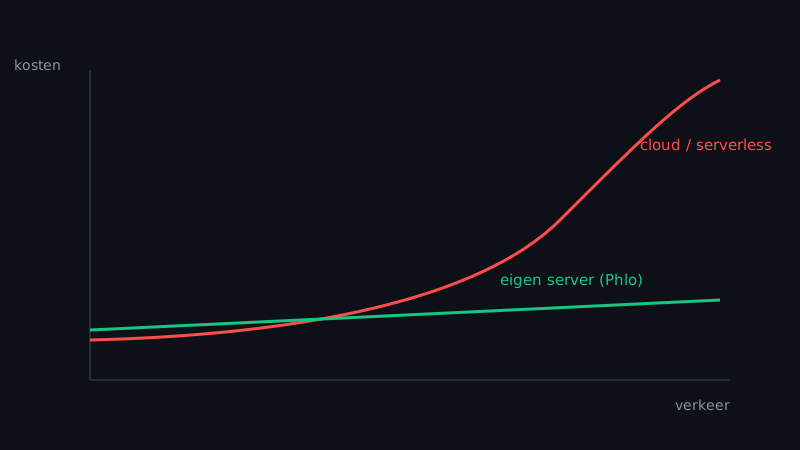
The cloud-first default treats infrastructure as a usage-metered utility, which turns growth into a liability: the more a product gets used, the more it costs just to keep running. Phlo reclaims the machine instead.
Running on FrankenPHP in worker mode keeps a Phlo app resident in memory, answering requests with minimal overhead. That is a server-based cost model: the economics are predictable because the same machine serves the hundredth visitor and the hundred-thousandth, and the number on the invoice does not bend upward with success. In that model the application tier is the cheap, easy part of the stack, engineering effort goes where it belongs (the data tier), and the Phlo Dashboard manages the fleet as an owned asset rather than rented capacity you never actually see.
AI integration minus the plumbing
Most frameworks need a sprawl of client-side libraries and hand-rolled Server-Sent-Events boilerplate to bolt on AI. Phlo treats it as a native part of the architecture instead: a single facade routes a request based on the model name, gpt-* to OpenAI, claude-* to Claude, without a separate client library or a separate event bus. Setting %res->streaming = true uses the same apply() protocol to stream tokens straight to the DOM, so the UI updates token by token with no manual flush() calls and no custom JavaScript glue.
Designed for an agent-first future
A tractable codebase has to be legible to humans and machines alike. Phlo leans on two things to make that real: SKILL.md, a complete language and build reference written so an agent can work on the codebase without prior training, and the reflect:: CLI, which exposes routes, views and the app's dependency graph as JSON. An agent working against that doesn't have to guess at the code, it can read the actual shape of the system, which makes the language about as easy for an AI to navigate as it is for an architect to audit.
Reclaiming the stack
Phlo is one system across four layers, which removes the need to translate between ecosystems on the way from an idea to a running fleet:
- The language: a custom
.phlosyntax that compiles to readable PHP, CSS and JS. - The application platform: an integrated SPA engine where
apply()handles frontend updates with no client-side glue. - The server platform: FrankenPHP worker mode for performance, with dedicated daemons for realtime events and the WhatsApp gateway.
- The operations platform: the Phlo Dashboard, managing the whole fleet from code to metal.
The standards a team accepts either help it build, or they are just ceremony between the team and the thing it is making. Phlo's bet is that a minimalist, integrated design is how you stop managing overhead and start actually owning what you ship.